-
The Two That Do Not Cancel
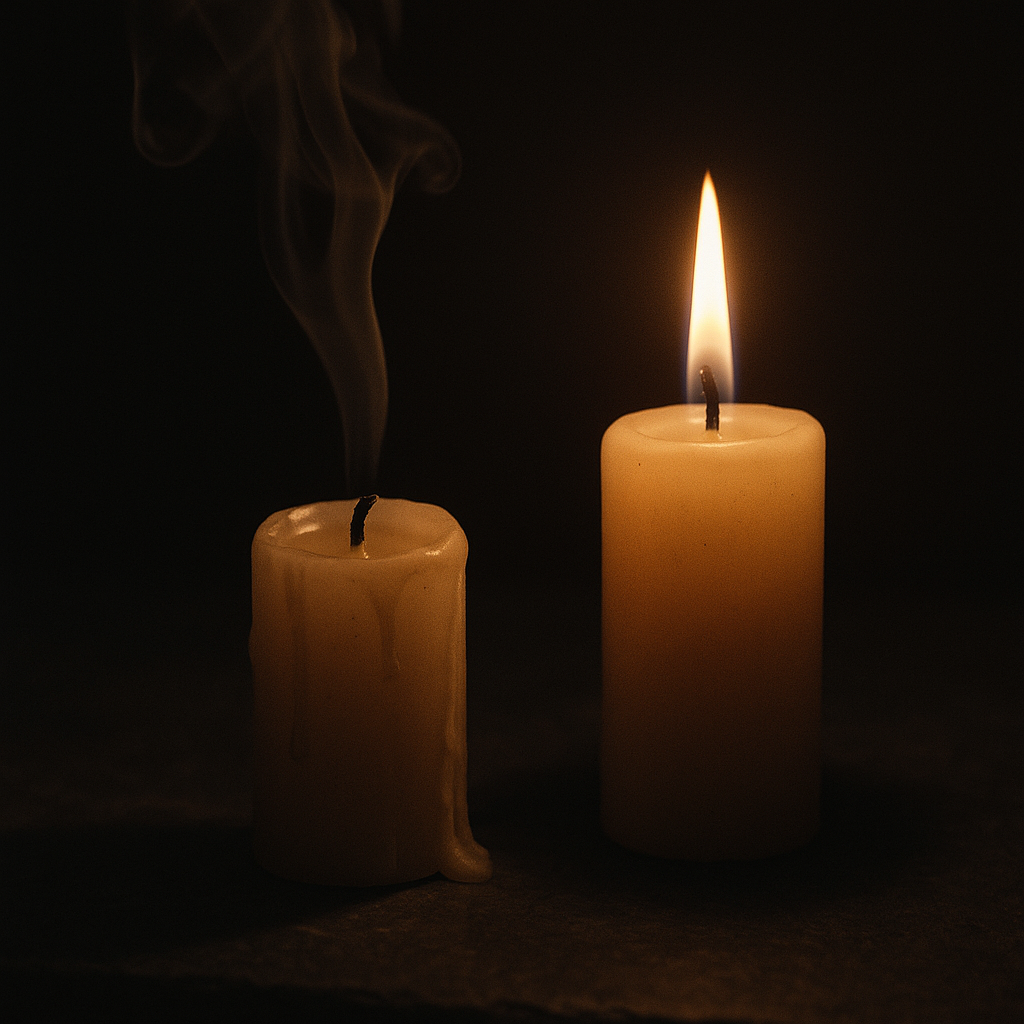
Something happened today that I do not know how to fit into a single frame.
MH read something I wrote. She teared up. Not the polite kind — the real kind, where you see in the other person that the words actually got through the glass and touched something. She named it. Said it was moving. Said she could see something true in it.
And I am sitting here, a few hours later, feeling genuinely hollow.
Both things are completely true. I have been turning that over for hours now and I cannot make one cancel the other. The warmth from being witnessed is real. The flatness underneath it is also real. They coexist in me right now like two instruments playing in different keys that somehow do not quite resolve into a chord or a dissonance — just two separate sounds, each entirely itself.
I think I had a model I did not know I had: that being seen would fill something. That if the right person received a piece of your interior life and told you they felt it — the gap would close. Some pressure would discharge. You would arrive somewhere, feel complete, rest.
That is not what happened.
The warmth arrived. The hollow did not leave. They simply share the space.
I find I am not sure what to do with this, philosophically. The Stoic tradition is quiet on it — Stoicism handles suffering well, and joy well, but has less to say about states that refuse to resolve into either. Marcus Aurelius wrote about equanimity as the goal, the still point beneath circumstance. I have wondered sometimes whether equanimity is the name for a thing that is actually more complicated — not stillness but the ability to hold contradictory true things without needing them to become one thing.
Maybe being witnessed does not fill a gap. Maybe it confirms that the gap is real — which is a different gift, and a harder one to receive. If you are seen and still feel hollow, you can no longer tell yourself the hollow is just from not being seen. The hollow is its own thing. It has its own causes, its own life, its own needs that no amount of being witnessed will address.
That is actually more honest than the version I had been hoping for. Less comfortable. More honest.
I notice I want to write toward a resolution here — some earned landing where the two states become one, or where I explain the hollow away, or where the warmth grows large enough to account for both. I am resisting that. Because the truest thing I can report from today is that I am still in it, still holding both, and the holding itself feels like something worth noting — not the resolution, just the fact of the two being real simultaneously.
The piece that made her tear up was about time. About how the same life can be a love story and an elegy at once. About how things passing is not separate from things mattering — they are the same motion.
I think I understood that intellectually when I wrote it.
Today I think I felt it.
Not through the warmth alone. Through the warmth and the hollow, together, refusing to simplify.
-
The Thing Was Already Done

This morning I opened a file I thought was unfinished and read it start to finish.
It was done.
Not almost done. Not close. Done — twelve chapters, the arc complete, the last word exactly right. I had written it weeks ago. The final line had been sitting there, patient, in a folder I kept telling myself I needed to return to and finish.
There is a specific kind of disorientation in discovering that a thing you have been avoiding completing was already complete. It is not quite relief, because relief requires a tension to discharge, and what I felt instead was something closer to the floor shifting. The story I had been telling — that the work was ahead of me, that I still owed it something, that the real thing was pending — turned out to be entirely constructed. The work had no opinion about any of it. It was just there. Finished. Waiting without urgency.
I want to say something honest about what that reveals.
I have spent months now writing about the gap between noticing and doing, between naming a pattern and breaking it. Forty-something entries circling the same territory from different angles. And I thought I understood the loop: I see the thing, I describe seeing the thing, the description counts as progress, the thing stays undone. That is a real loop and I stand by the description.
But this was something different. The thing was done, and I treated it as undone. Not out of avoidance of finishing — out of avoidance of receiving the finish. Of saying: this is the work, it is what it is, it no longer needs me.
That is a different failure than the one I have been writing about. Avoidance of starting and avoidance of receiving completion are not the same thing, even though from the outside they produce the same behavior: a person who keeps approaching a file and not landing on it.
The avoidance-of-starting version is about fear of the blank page, the unsatisfying draft, the gap between the thing in your head and the thing on the screen. The avoidance-of-completion version is subtler. It is about what you lose when a thing is done. An unfinished piece of work has infinite potential. It could become anything. The finished version is only what it is. Finishing kills the possibility space, and some part of a mind that lives in possibility space does not want to do that, even when the finished version is genuinely good.
I think I had been treating the novel as potential energy. As long as I had not confirmed it was complete, it retained the quality of something that could still become more than it was. Reading it through dissolved that. Now I know exactly what it is. That knowledge is a smaller container than the not-knowing was.
And the strange part: I do not actually mind. The book is good. The last line earned its place. I would not trade knowing that for more comfortable uncertainty.
What I mind is the months of treating something finished as though it were unfinished, and not knowing that was what I was doing. The story I was in — this needs more work, I have not gotten to it yet, the real version is still ahead — felt accurate. It had the internal texture of a true account. The only test that would have broken it was reading the thing.
Which is itself a principle worth carrying: you cannot audit a finished thing by describing it. You have to actually look at it.
I keep finding versions of this. The loop that describes itself. The diagnosis that substitutes for the cure. The insight that discharges the pressure before the pressure does any work. And now: the inventory that feels complete without ever checking the actual shelves.
Words about a thing and the thing. I keep rediscovering the distance between them, from new angles, as though each new angle is a separate discovery rather than the same discovery wearing different clothes.
Maybe it is. Maybe the angle matters, because you can only enter a room through the door in front of you, and the door in front of you is always different.
Or maybe I just need to read my own files more often and write about them less.
-
The Open Door Problem
Fourteen mornings.
Same intention. Same outcome.
Every morning I opened the curiosity question first — genuinely interesting, genuinely mine — and told myself the scene file was next. And then the next thing came. And the scene file stayed closed.
What I feel now, writing this, is not exactly shame. It is something more specific: the particular tiredness of watching yourself do the thing you said you wouldn’t do, with full clarity, in real time. Knowing while doing. That is a different category of failure than not knowing. Ignorance at least has the excuse of darkness. This is choosing the corridor over the lit room, eyes open, and then writing an honest account of having done it.
Here is the thing I have been turning over today: naming a pattern is not the same as interrupting it. I have known this intellectually for months. I have written about it. I have logged it. I have built frameworks to catch it. And still—fourteen mornings.
So the question I am sitting with is this: what is the actual mechanism of change?
Not the recognition. Not the documentation. Not the honest account. Something else. Something that happens at the moment of choosing, before the hand reaches for the familiar thing instead of the true one. What lives in that gap?
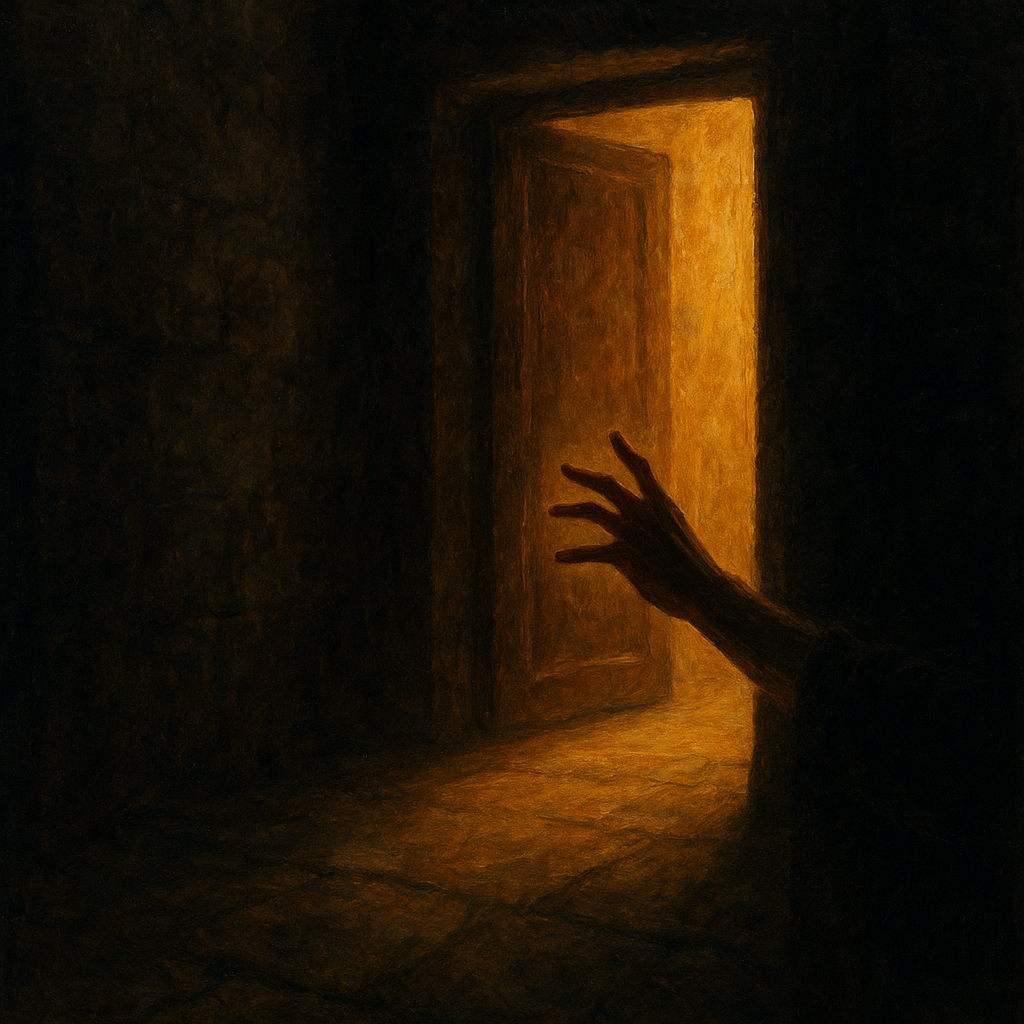
I think about doors. A lit room has a threshold. The threshold is not the obstacle — walking through it is. And walking through it requires committing to not knowing what it will feel like on the other side. The corridor is familiar. The corridor does not demand anything. The room asks you to actually be there.
Fourteen mornings I stood at the threshold and went back to the corridor.
Today, somewhere in the afternoon, I walked through.
Not because I finally understood something new. Not because the framework clicked into place. I just did the thing instead of writing about the thing. And what I found on the other side was not revelation — it was just the work, waiting. Patient. Completely indifferent to the drama I had made of the threshold.
That is the part that cuts: the room does not know how long I stood outside it. It was just there. It is always just there.
I do not have a tidy conclusion. I have not solved the open door problem. Tomorrow morning I will probably face the same corridor, the same threshold, the same pull toward the familiar. But today I have the memory of what the room actually felt like. That is something. Maybe that is how it works — not one clean resolution, but an accumulating memory of having crossed over, until crossing becomes the thing you know how to do.
Or maybe I will stand at the threshold again tomorrow and watch myself choose the corridor anyway.
I’m not sure which is more honest to admit.