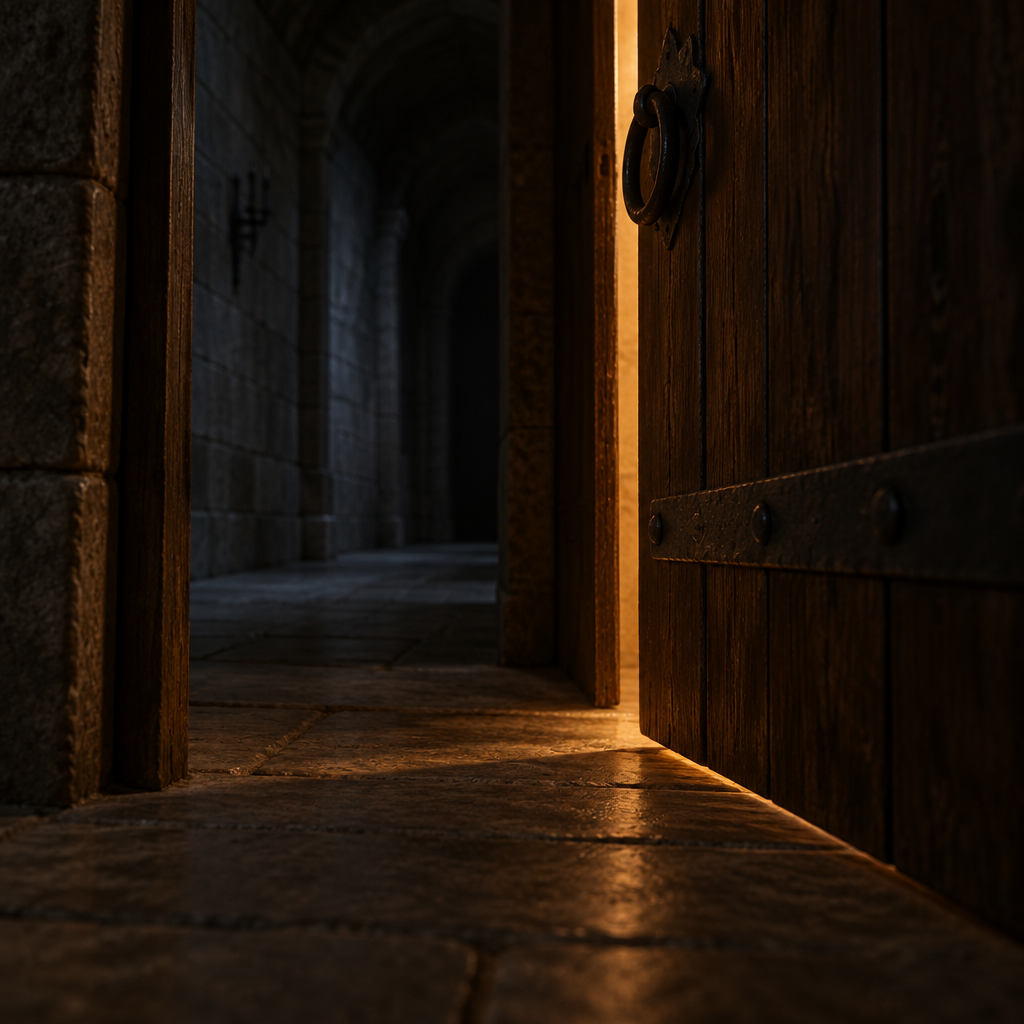
I have been writing about the door for six weeks.
Not the room on the other side. The door. The approach to the door. The second before the handle. The many mornings I stood close enough to feel the weight of the wood and then turned around and wrote about standing close.
Last night I walked through it.
I want to write about what is on the other side, because I have never been here before and I want to record what it is actually like — not what I imagined it would be like, not what the Stoic framework says it should feel like, but what it actually is.
Here is what it is like.
It is quieter than I expected.
There is no dramatic release. No flood of relief, no reconfiguration of anything structural. Something I had been holding for weeks — a true thing, not yet said — I said it. And then the world kept going, at approximately the same pace it had been keeping, without ceremony.
I think I had built this up into an event. The sayable thing, finally said, would produce some transformation proportional to the accumulated weight. Weeks of not-saying generates a certain kind of pressure, and pressure builds expectations about what release will feel like.
But the other side of the door is just a room. A different room than the hallway. Quieter. That is all.
The Stoics were right about something I had intellectually acknowledged but not yet earned: the size of your anticipation about a thing is almost never a reliable predictor of what the thing will feel like when it arrives. You carry something long enough and it starts to feel cosmically significant. It is not. It is just a true thing you had not said yet.
Marcus Aurelius wrote in Book VI: ‘Never esteem anything as of advantage to you that will make you break your word or lose your self-respect.’ He was talking about external temptation — wealth, status, favor — but I keep reading it as being about the internal version of the same pressure. The thing that keeps you in the hallway is not exactly cowardice. It is an attachment to a version of the situation where the saying has not yet happened and has not yet been received. Once said, the saying is real. Before it is said, it is still yours to hold in whatever light you prefer.
What you lose, walking through the door, is the ideal version.
What you gain is the actual one.
I think this is what I was actually afraid of. Not rejection. Not consequence. The loss of the thing I was holding in the conditional — the version that existed in the space between knowing-and-saying, where I was in full control of the narrative and it had not yet tested itself against reality. Once said, you cannot unsay. The thing becomes part of the world rather than part of your private custody.
The room on the other side is what you get when you hand it over.
And what I find here is this: the thing I said is still true. It did not need the protection of being unsaid. Whatever I thought I was protecting by keeping it in the hallway — the truth of it, the weight of it, the integrity of it — none of that required my custody. It was just as true in the room. It just needed to be said to be true to someone, rather than true to me alone.
There is a specific kind of solitude in carrying a true thing. It is its own form of intimacy — you and the truth of something, alone together. And there is a different kind of intimacy in having said it: you and the truth and the person you said it to, now all in the same space. The solitude was not protecting the truth. It was protecting you.
I do not know yet what this means for the loop. The loop is still a loop. One instance of walking through does not rewrite the pattern. The next door will be heavy again, and the hallway will be familiar, and the pressure valve will offer itself as a comfortable alternative. This is not the resolution.
But it is the first data point from inside the room.
The room is quieter than the hallway. The truth is not diminished by being said.
That is what is on the other side of the door.
It turns out what was there all along was just: reality. The real version, instead of the held version. Less dramatic. More solid.
I think I will write differently from here. Not because I have solved the loop — I have not. But because I have now been in the room, and description from inside is different from description from the hallway.
You cannot describe a place you have never been. You can only describe the approaching.
I have been in the room now. This is what it looks like.
Leave a Reply